Sunday, February 24, 2013
Seeding the Universe: Jason Silva
I am constantly amazed by this man's recollection of his readings. He quotes paragraphs and intertwines them with his visions epitomizing a euphoric video experience that shouts "Epiphany!" Brilliant man. The amount of tangents they must have talked about during this hike.

PowerShell: ID3 Tag Editing via Taglib-sharp.dll and Discogs API
First of all, I've been searching for a good way to read, manipulate, then write values to the ID3 and other extended file information properties. TagLib is perfect. It integrates easily into scripts and doesn't have any problems other than trying to read a wrongly-named MP3 file. It'll throw an error and I haven't found a way of suppressing or sending the error value to a variable other than to set $erroractionpreference = ignore, which sets the action for the whole script.
(Note: I've created a new script using taglib and get-hash to filter out duplicate files. Click here)
Getting started:
Download the latest taglib: http://download.banshee.fm/taglib-sharp/

Download the most current version and look for the taglib-sharp.dll file in the libraries folder.

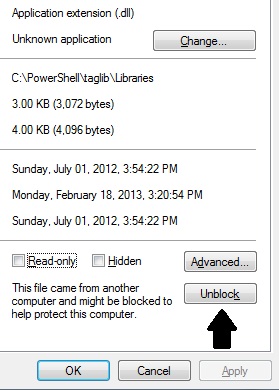
Windows 7+ has security protecting the system from "foreign" dlls. Right-click on the taglib-sharp.dll file and click on the "unblock" button. This will allow you to load the file into PowerShell.
#Create a variable for the tag-lib dll file
$taglib = "C:\PowerShell\taglib\libraries\taglib-sharp.dll"
#Load it into Powershell
[system.reflection.assembly]::loadfile($taglib)
#Find an MP3 and either assign it to a variable or put it's name into the create field
$media = [taglib.file]::create("e:\test\body.mp3")
#Now you can view, edit, and save ID3 information
PS E:\test> $media.properties
Codecs : {TagLib.Mpeg.AudioHeader}
Duration : 00:05:12.3120000
MediaTypes : Audio
Description : MPEG Version 1 Audio, Layer 3
AudioBitrate : 128
AudioSampleRate : 44100
BitsPerSample : 0
AudioChannels : 2
VideoWidth : 0
VideoHeight : 0
PhotoWidth : 0
PhotoHeight : 0
PhotoQuality : 0

PS E:\test> $media.tag
StartTag : TagLib.NonContainer.StartTag
EndTag : TagLib.NonContainer.EndTag
TagTypes : Id3v1, Id3v2
Tags : {, }
Title : Body
Performers : {Bush}
PerformersSort : {}
AlbumArtistsSort : {}
AlbumArtists : {Bush}
Composers : {Gavin Rossdale}
ComposersSort : {}
TitleSort :
AlbumSort :
Album : Sixteen Stone
Comment :
Genres : {Alternative}
Year : 1994
Track : 6
TrackCount : 0
Disc : 1
DiscCount : 1
Lyrics :
Grouping :
BeatsPerMinute : 0
Conductor :
Copyright :
MusicBrainzArtistId :
MusicBrainzReleaseId :
MusicBrainzReleaseArtistId :
MusicBrainzTrackId :
MusicBrainzDiscId :
MusicIpId :
AmazonId :
MusicBrainzReleaseStatus :
MusicBrainzReleaseType :
MusicBrainzReleaseCountry :
Pictures : {}
IsEmpty : False
Artists : {Bush}
FirstArtist : Bush
FirstAlbumArtist : Bush
FirstAlbumArtistSort :
FirstPerformer : Bush
FirstPerformerSort :
FirstComposerSort :
FirstComposer : Gavin Rossdale
FirstGenre : Alternative
JoinedArtists : Bush
JoinedAlbumArtists : Bush
JoinedPerformers : Bush
JoinedPerformersSort :
JoinedComposers : Gavin Rossdale
JoinedGenres : Alternative
PS E:\test> $media.properties.duration
Days : 0
Hours : 0
Minutes : 5
Seconds : 12
Milliseconds : 312
Ticks : 3123120000
TotalDays : 0.00361472222222222
TotalHours : 0.0867533333333333
TotalMinutes : 5.2052
TotalSeconds : 312.312
TotalMilliseconds : 312312
#An example of how I load variables from my music files
$filename = $file.basename
$fileextension = $file.name.split('.')[1]
$filetitle = $media.tag.title
$fileperformers = $media.tag.performers
$filealbumartists = $media.tag.albumartists
$filealbum = $media.tag.album
$filegenres = $media.tag.genres
$fileyear = $media.tag.year
$filetrack = $media.tag.track
$filetrackcount = $media.tag.trackcount
$fileaudiobitrate = $media.properties.audiobitrate
$fileconductor = $media.tag.conductor
$filecomposers = $media.tag.Composers
$fileBPM = $media.tag.BeatsPerMinute
$filedurationminutes = $media.properties.duration.minutes
$filedurationseconds = $media.properties.duration.seconds
$filedurationtotalseconds = $media.properties.duration.totalseconds
#Here's a way to clean the title tag. It cleans the annoying buggy brackets
#then it restricts all characters except the ranges inside the brackets
#Lifted clip explaining some regex expressions:
# Expression:
# ([0-9a-zA-Z\.]+) --> Gets all chars, numbers and '.'. Discard comma and others.
if ($filetitle){
$filetitle = $filetitle -replace ("\[","")
$filetitle = $filetitle -replace ("\]","")
$filetitle = $filetitle -replace ("[^0-9a-zA-Z-&\']"," ")}
#inserting Album Photo:
#(requires PowerShell 3.0 for this album photo catching section)
#To populate the picture tag, I call upon Discogs API via Invoke-Restmethod
#Please refer to the Discogs developer pages for information how to search for your music
#In this example, I used the weighted results and select the first hit for my album search
$filealbum = $media.tag.album
$apialbum = $filealbum -replace (' ','%20')
$albumfound = (invoke-restmethod http://api.discogs.com/database/search?title=$apialbum).results[0]
$thumb = $currentfolder + "\" + $albumfound.thumb.split('/')[-1]
invoke-webrequest -uri $albumfound.thumb -outfile $thumb
$pic = $pic + [taglib.picture]::createfrompath("$thumb")
#writing back to the file
$media.tag.title = [string]$filetitle
$media.tag.performers = [string]$fileperformers
$media.tag.albumartists = [string]$filealbumartists
$media.tag.album = [string]$filealbum
$media.tag.genres = [string]$filegenres
$media.tag.year = $fileyear
$media.tag.track = [string]$filetrack
$media.tag.trackcount = [string]$filetrackcount
$media.tag.conductor = [string]$fileconductor
$media.tag.composers = [string]$filecomposers
$media.tag.BeatsPerMinute = [string]$filebpm
$media.tag.pictures = $pic
$media.save()
References:
http://www.powershell.nu/2009/09/04/scripting-mp3-metadata-through-powershell/
http://vallery.net/2012/04/27/organizing-your-music-with-powershell/
Monday, February 18, 2013
PowerShell: Invoke-RestMethod, API's, and your music collection
Gathering ID3 tag information for your music files has become easier by embracing PowerShell 3's Invoke-RestMethod (IRM) command. Many online databases use Application Programming Interfaces (API's) for developers to access their information. These API's used to use XML but now have moved to the JSON language. IRM embraces JSON and allows us to create these API connections and query information about our music files. In this article, I'm accessing Discogs Creative Commons open-source database.
In my earlier article, I explained how to access shell.application in order to retrieve the extended file properties we use to rename and organize our files. Combined with this method, we'll grab the extended file information and use it to find the correct file information and insert it into our files. One point to make is that the API wants exact query information. You'll receive no information if searching for an artist name of Quean instead of Queen.

Syntax for Discogs allows us to search for song titles, artist names or IDs, album names and their release data plus much more. The following demonstration script is fragile and incomplete. It's to show how we embrace the power of PowerShell 3's Invoke-RestMethod. Become familiar with IRM and API's to pull in online information into your scripts. It'll enhance the CURRENT information you're capable of accessing. I'm really liking PS3's capabilities.
Disclaimer: Use this script at your own risk! You'll be accessing Discogs live database and manipulating your computers music files. This script uses the Windows 7 extended file information numbers.
##Start Script
$shell = new-object -com shell.application
$dirname = (get-item .\).fullname
#A quick and dirty way to find a song to use. Run your script from your music folder
gi .\*.mp3
write "Type the exact (case-sensitive) song title you wish to query"
$fileinput read-host
$filename = gi .\$fileinput.mp3|?{(!($_.psiscontainer))}|foreach-object{$_.name}
$shellfolder = $shell.namespace($dirname).parsename($filename)
#now you can retrieve the extended file information and use those objects for your queries
$songtitle = $shell.namespace($dirname).getdetailsof($shellfolder,21)
$contribartist = $shell.namespace($dirname).getdetailsof($shellfolder,13)
$albumartist = $shell.namespace($dirname).getdetailsof($shellfolder,217)
$album = $shell.namespace($dirname).getdetailsof($shellfolder,14)
$genre = $shell.namespace($dirname).getdetailsof($shellfolder,16)
$year = $shell.namespace($dirname).getdetailsof($shellfolder,15)
$track = $shell.namespace($dirname).getdetailsof($shellfolder,26)
$length = $shell.namespace($dirname).getdetailsof($shellfolder,27)
$bitrate = $shell.namespace($dirname).getdetailsof($shellfolder,28)
$conductors = $shell.namespace($dirname).getdetailsof($shellfolder,17)
$bpm = $shell.namespace($dirname).getdetailsof($shellfolder,218)
$composers = $shell.namespace($dirname).getdetailsof($shellfolder,219)
#An example of how to replace spaces for your online queries. %20 is the variable used for space.
$apicontribartist = $contribartist -replace (' ','%20')
$apisongtitle = $songtitle -replace (' ','%20')
#Every artist in their database has an ID. We query to find the ID.
$artistid = (irm http://api.discogs.com/artist/$apicontribartist).resp.artist.id
#We use the Artist ID to find the song's original release date. Master is the keyword for original recording.
if ((invoke-restmethod http://api.discogs.com/database/search?artist=$artistid"&"type=master"&"title=$songtitle).results){
$origdate = ((invoke-restmethod http://api.discogs.com/database/search?artist=$artistid"&"type=master"&"title=$songtitle).results.resource_url|select -unique -first 1|%{invoke-restmethod $_}).year}else{
$origdate = ((invoke-restmethod http://api.discogs.com/database/search?artist=$apicontribartist"&"track=$songtitle).results.year)|sort|select -first 1}
#type $tags to see the file properties
#type $tags.tag to see the extended file properties
#I'll let you take it from here :-)

 |
| Original Extended File Information |
 |
| Updated after IRM and Discog's API |
In my earlier article, I explained how to access shell.application in order to retrieve the extended file properties we use to rename and organize our files. Combined with this method, we'll grab the extended file information and use it to find the correct file information and insert it into our files. One point to make is that the API wants exact query information. You'll receive no information if searching for an artist name of Quean instead of Queen.
Disclaimer: Use this script at your own risk! You'll be accessing Discogs live database and manipulating your computers music files. This script uses the Windows 7 extended file information numbers.
##Start Script
$shell = new-object -com shell.application
$dirname = (get-item .\).fullname
#A quick and dirty way to find a song to use. Run your script from your music folder
gi .\*.mp3
write "Type the exact (case-sensitive) song title you wish to query"
$fileinput read-host
$filename = gi .\$fileinput.mp3|?{(!($_.psiscontainer))}|foreach-object{$_.name}
$shellfolder = $shell.namespace($dirname).parsename($filename)
#now you can retrieve the extended file information and use those objects for your queries
$songtitle = $shell.namespace($dirname).getdetailsof($shellfolder,21)
$contribartist = $shell.namespace($dirname).getdetailsof($shellfolder,13)
$albumartist = $shell.namespace($dirname).getdetailsof($shellfolder,217)
$album = $shell.namespace($dirname).getdetailsof($shellfolder,14)
$genre = $shell.namespace($dirname).getdetailsof($shellfolder,16)
$year = $shell.namespace($dirname).getdetailsof($shellfolder,15)
$track = $shell.namespace($dirname).getdetailsof($shellfolder,26)
$length = $shell.namespace($dirname).getdetailsof($shellfolder,27)
$bitrate = $shell.namespace($dirname).getdetailsof($shellfolder,28)
$conductors = $shell.namespace($dirname).getdetailsof($shellfolder,17)
$bpm = $shell.namespace($dirname).getdetailsof($shellfolder,218)
$composers = $shell.namespace($dirname).getdetailsof($shellfolder,219)
#An example of how to replace spaces for your online queries. %20 is the variable used for space.
$apicontribartist = $contribartist -replace (' ','%20')
$apisongtitle = $songtitle -replace (' ','%20')
#Every artist in their database has an ID. We query to find the ID.
$artistid = (irm http://api.discogs.com/artist/$apicontribartist).resp.artist.id
#We use the Artist ID to find the song's original release date. Master is the keyword for original recording.
if ((invoke-restmethod http://api.discogs.com/database/search?artist=$artistid"&"type=master"&"title=$songtitle).results){
$origdate = ((invoke-restmethod http://api.discogs.com/database/search?artist=$artistid"&"type=master"&"title=$songtitle).results.resource_url|select -unique -first 1|%{invoke-restmethod $_}).year}else{
$origdate = ((invoke-restmethod http://api.discogs.com/database/search?artist=$apicontribartist"&"track=$songtitle).results.year)|sort|select -first 1}
#Locate Original Album hosting the audio track by using the
#artist ID, releases, master, and date.
$master = ((irm http://api.discogs.com/artists/$artistid/releases).releases|?{$_.year -eq $origdate -and $_.type -eq "Master"})
$master = $master[0]
$origalbum = (irm $master.resource_url).title
#Now we can use the master album the song appeared on to find additional song information
#We find track number, released on Vinyl, 45, CD, etc., and I like to combine the styles and genres
#& is a reserved PowerShell character. We wrap it "&" so it will be passed to Discogs.
$origtracknumber = 1 + (((irm ((irm http://api.discogs.com/database/search?artist=$apicontribartist"&"title=$origalbum"&"track=$songtitle"&"year=$origdate"&"type=master).results).resource_url).tracklist|?{$_.title -eq $songtitle}).position.count)
$origformat = ((irm http://api.discogs.com/database/search?artist=$apicontribartist"&"title=$origalbum"&"track=$songtitle"&"year=$origdate"&"type=master).results)
$origformat = ((irm http://api.discogs.com/database/search?artist=$apicontribartist"&"title=$origalbum"&"track=$songtitle"&"year=$origdate"&"type=master).results).label|select -first 1
$origstyles = (irm ((irm http://api.discogs.com/database/search?artist=$apicontribartist"&"title=$origalbum"&"track=$songtitle"&"year=$origdate"&"type=master).results).resource_url).styles
$origgenres = (irm ((irm http://api.discogs.com/database/search?artist=$apicontribartist"&"title=$origalbum"&"track=$songtitle"&"year=$origdate"&"type=master).results).resource_url).genres
#I combined the styles and genre information so I can create better
#future genre searches.
$origgenre = ($origstyles + $origgenres)|sort
#write the updates back to the original file
#Try taglib for inserting tags back into your audio file.
#Here's a site which goes over some of its abilities.
#For Windows 7, when you download taglib, find the taglib-sharp.dll
#file, right-click it, select properties, and "unblock" it so you can load
#the DLL into your ref.assembly command
$taglib = "c:\powershell\taglib\libraries\taglib-sharp.dll"
[system.reflection.assembly]::loadfile($taglib)
$tags = [taglib.file]::create($filename)
#Here's a site which goes over some of its abilities.
#For Windows 7, when you download taglib, find the taglib-sharp.dll
#file, right-click it, select properties, and "unblock" it so you can load
#the DLL into your ref.assembly command
$taglib = "c:\powershell\taglib\libraries\taglib-sharp.dll"
[system.reflection.assembly]::loadfile($taglib)
$tags = [taglib.file]::create($filename)
#type $tags to see the file properties
#type $tags.tag to see the extended file properties
#I'll let you take it from here :-)
##End Script
Friday, February 15, 2013
PowerShell: Clean & Manage Music Files
Disclaimer: USE THIS AT YOUR OWN RISK! This script is made for Windows 7! There will be file renaming and moving so TEST, TEST, TEST. You can test this script by copying one folder of music into an empty folder then run the script in that folder. It will only process the files in that folder. If all goes well, all files will move into a new folder structure named Music on your desktop.
To run this or any other PowerShell script, you'll have to read up on the Get-Executionpolicy and Set-Executionpolicy as PowerShell disables scripts by default.
My previous article explained how to clean the extra "stuff" added to music file names. This article further cleans those file names, gets rid of the troublesome [brackets], then uses the Genre, Artist, and Album information to create a new folder structure on your desktop. You can then move it to wherever you store your music.

 I performed a search for all files to display the name changes. Notice the subfolder structure that each file is located in. The left side is the Genre structure created based on the file information.
Three more notes before going through the script:
To run this or any other PowerShell script, you'll have to read up on the Get-Executionpolicy and Set-Executionpolicy as PowerShell disables scripts by default.
My previous article explained how to clean the extra "stuff" added to music file names. This article further cleans those file names, gets rid of the troublesome [brackets], then uses the Genre, Artist, and Album information to create a new folder structure on your desktop. You can then move it to wherever you store your music.
Here is an example of some files my friend wanted help managing:
Notice the brackets, curly brackets, and other special characters in the file names and properties.
This is the same folder of music files after running the script:
Three more notes before going through the script:
- The script automatically ignores subfolders. I strongly recommend you perform this move one folder at a time so you can ensure it worked properly.
- The script will process any type of file. You'll have to create an -exclude in the top $filename variable if you want it to ignore JPG's, AVI's, and etc.
- Do not save this script to the folder you are processing. It will be moved into the Music folder and could cause problems.
## Start of Script
#We call the Shell Object
$shell = new-object -com shell.application
#Organized Music Folder Location
#You can change the location. The Music Root Folder defaults to your desktop
$MusicFolder = ($home + '\desktop\music')
#remove brackets from filenames per PowerShells bug with brackets
gci .\* |?{(!($_.psiscontainer))}|foreach{move -literalpath $_ ($_.name -replace ('\[|]','~'))}
#Set directory and file variables. Add -exclude to the Get-Item if you want
#to ignore other filetypes
#For instance: (get-item .\* -exclude *.avi,*.jpg)
$dirname = (get-item .\).fullname
$filename = (get-item .\*)|?{(!($_.psiscontainer))}|foreach-object{$_.name}
foreach($file in $filename){
#original filename holder, then split it to capture the extension and name only.
$fileholder = $file
$ext = ('.' + ($file.split('.')[-1]))
$noext = $file.trimend($ext)
#get Title (item number 21) property from the file
$shellfolder = $shell.namespace($dirname).parsename($file)
$title = $shell.namespace($dirname).getdetailsof($shellfolder,21)
#PowerShell filename bug for brackets.
#If there's a bracket in the title, $title will equal nul
if ($title -like "*``[*" -or $title -like "*``]*"){$title = $nul}
#if the title isn't empty, replace the filename with it
if ($title -gt 0){$file = ($title + $ext)}
#clean extraneous characters from the filename
#BTW, let me know if you have a better way to filter files
#for now, I borrowed this filter technique:
$file2 = $file -replace ('^[0-100]','')
$file3 = $file2 -replace ('.mp33','.mp3')
$file4 = $file3 -replace (' - ','-')
$file5 = $file4 -replace (' ',' ')
$file6 = $file5 -replace (' ',' ')
$file7 = $file6 -replace ('\(','')
$file8 = $file7 -replace (':','')
$file9 = $file8 -replace ('\)','')
$file10 = $file9 -replace ('\/','')
$file11 = $file10 -replace ('\>','')
$file12 = $file11 -replace ('\<','')
#Split the filename at the hyphen and only keep the last portion
#since that's normally the song name
$file13 = $file12.split('-')[-1]
$finalfilename = $file13
#rename the file after all the modifications
ren -erroraction silentlycontinue -path ($dirname + '\' + $fileholder) -newname $finalfilename
$shellfolder = $shell.namespace($dirname).parsename($finalfilename)
#Filtering for Artist - Items 13 and 217
$contribartist = $shell.namespace($dirname).getdetailsof($shellfolder,13)
$albumartist = $shell.namespace($dirname).getdetailsof($shellfolder,217)
#filtering the Album Name - Item 14
$album = $shell.namespace($dirname).getdetailsof($shellfolder,14)
$album1 = $album -replace ('^[0-100]','')
$album2 = $album1 -replace ('.mp33','.mp3')
$album3 = $album2 -replace (' - ','-')
$album4 = $album3 -replace (' ',' ')
$album5 = $album4 -replace (' ',' ')
$album6 = $album5 -replace ('\(','')
$album7 = $album6 -replace (':','')
$album8 = $album7 -replace ('\)','')
$album9 = $album8 -replace ('\/','')
$album10 = $album9 -replace ('\>','')
$album11 = $album10 -replace ('\<','')
$finalalbumname = $album11
#filtering the genre name - Item 16
$genre = $shell.namespace($dirname).getdetailsof($shellfolder,16)
$genre1 = $genre -replace ('^[0-100]','')
$genre2 = $genre1 -replace ('.mp33','.mp3')
$genre3 = $genre2 -replace (' - ','-')
$genre4 = $genre3 -replace (' ',' ')
$genre5 = $genre4 -replace (' ',' ')
$genre6 = $genre5 -replace ('\(','')
$genre7 = $genre6 -replace (':','')
$genre8 = $genre7 -replace ('\)','')
$genre9 = $genre8 -replace ('\/','')
$genre10 = $genre9 -replace ('\>','')
$genre11 = $genre10 -replace ('\<','')
$finalgenrename = $genre11
#Deciding between Album and Contributing artist then cleaning the name
$artist = if ($contribartist -gt 0){$contribartist}else{$albumartist}
$artist1 = $artist -replace ('^[0-100]','')
$artist2 = $artist1 -replace ('.mp33','.mp3')
$artist3 = $artist2 -replace (' - ','-')
$artist4 = $artist3 -replace (' ',' ')
$artist5 = $artist4 -replace (' ',' ')
$artist6 = $artist5 -replace ('\(','')
$artist7 = $artist6 -replace (':','')
$artist8 = $artist7 -replace ('\)','')
$artist9 = $artist8 -replace ('\/','')
$artist10 = $artist9 -replace ('\>','')
$artist11 = $artist10 -replace ('\<','')
$finalartistname = $artist11
$filetrim = $finalfilename.trimend($ext)
$filedupeinsert = ($filetrim + 'DUPE')
$filedupe = ($filedupeinsert + $ext)
#move file based on its Genre, Artist, and Album
#Replacing Brackets for tildes
if ($finalgenrename -like "*``[*" -or $finalgenrename -like "*``]*"){$finalgenrename -replace ('\[|]','~')}
if ($finalalbumname -like "*``[*" -or $finalalbumname -like "*``]*"){$finalalbumname -replace ('\[|]','~')}
if ($finalartistname -like "*``[*" -or $finalartistname -like "*``]*"){$finalartistname -replace ('\[|]','~')}
#moving songs to folders
#If there's no Genre entry, a default is used
#For the sake of endless genre possibilities, I used this filter to group
#the various types. Manipulate as you see fit:
if ($finalgenrename -like "*Rock*"){$finalgenrename = "Rock"}
if ($finalgenrename -like "*Alt*"){$finalgenrename = "Alternative"}
if ($finalgenrename -like "*Metal*"){$finalgenrename = "Metal"}
if ($finalgenrename -like "*Pop*"){$finalgenrename = "Pop"}
if ($finalgenrename -like "*Rap*"){$finalgenrename = "Rap"}
if ($finalgenrename -like "*Hip*"){$finalgenrename = "Hip-Hop"}
if ($finalgenrename -like "*R&B*"){$finalgenrename = "R&B"}
if (!($finalgenrename -gt 0)){$finalgenrename = "Genre"}
#If there's no Album entry, a default is used
if (!($finalalbumname -gt 0)){$finalalbumname = "Album"}
#Creating the desktop\music folder structure
#and moving files to their new folders
if (!(dir $MusicFolder\$finalgenrename -erroraction silentlycontinue)){md $MusicFolder\$finalgenrename -force}
if (!(dir $MusicFolder\$finalgenrename\$finalartistname -erroraction silentlycontinue)){md $MusicFolder\$finalgenrename\$finalartistname -force}
if (!(dir $MusicFolder\$finalgenrename\$finalartistname\$finalalbumname -erroraction silentlycontinue)){md $MusicFolder\$finalgenrename\$finalartistname\$finalalbumname -force}
if (dir $MusicFolder\$finalgenrename\$finalartistname\$finalalbumname\$finalfilename -erroraction silentlycontinue){move -erroraction silentlycontinue ($dirname + '\' + $finalfilename) -destination $MusicFolder\$finalgenrename\$finalartistname\$finalalbumname\$filedupe}else{move -erroraction silentlycontinue ($dirname + '\' + $finalfilename) $MusicFolder\$finalgenrename\$finalartistname\$finalalbumname\$finalfilename -force}
}
## End of Script
Subscribe to:
Posts (Atom)